
In 2011 A16Z predicted that software would eat the world, and they were right. Software can now stock up our fridge, connect us online and spot early signs of cancer.
But when it comes to reverting years of industrial destruction of the planet, software has its limitations. Slowing down climate change requires a systematic shift – from manufacturing to agriculture – which takes hardware. Software can play an important role in fighting climate change too, though.
It can drive the development and deployment of hardware solutions, provide data-driven insights and optimise systems. In this article, we’ll spotlight some industries where software moves the needle on climate change.
The climate tech startup software landscape
While software startups alone won’t make us reach Net Zero by 2050, they can get us there faster. In the last five years, a wave of climate tech startups have emerged that use software to combat climate change.
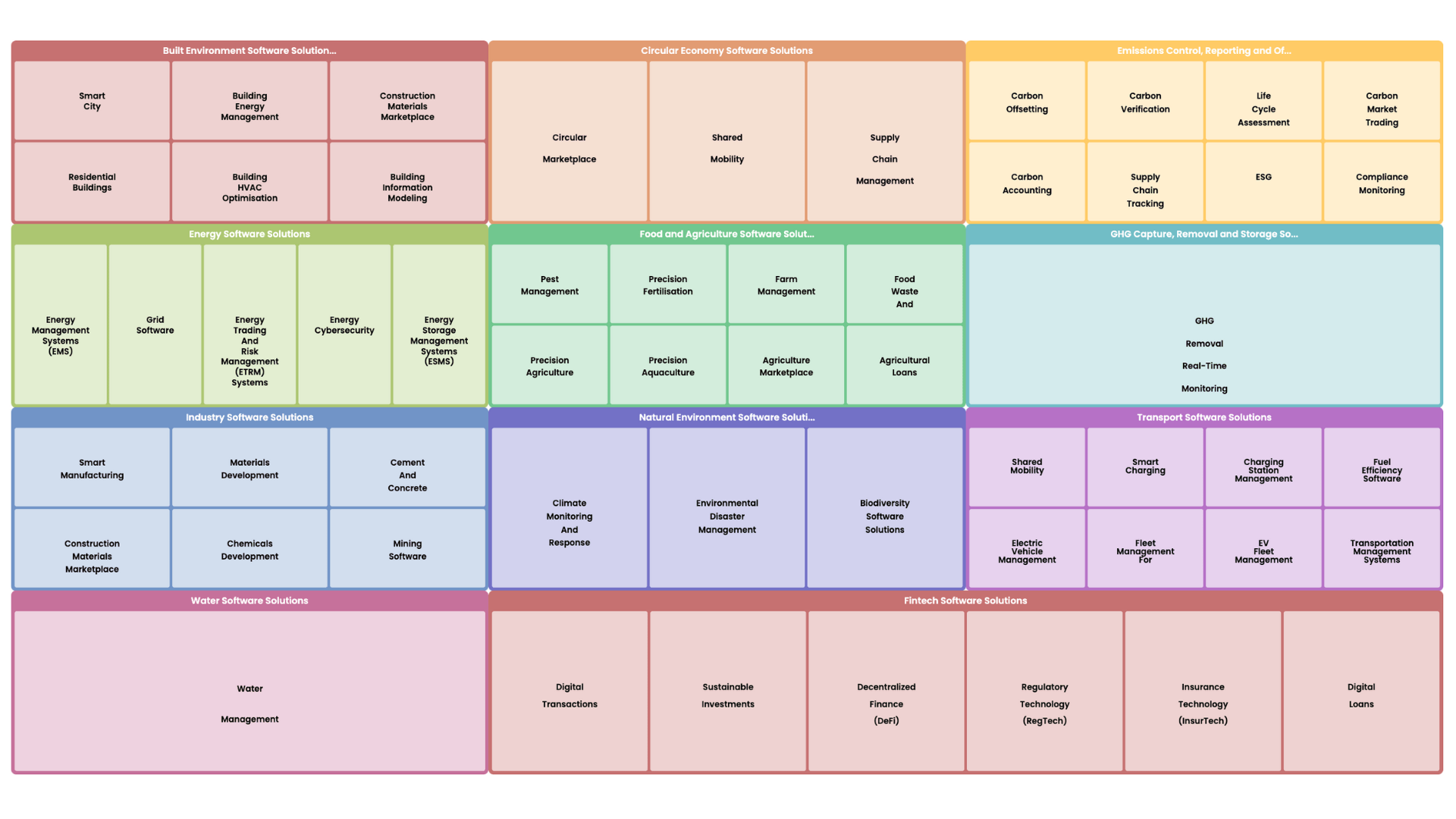
Our market map categorises climate tech startups building software solutions across industries like energy, agriculture and disaster management.
While this is just a handful of industries where we’ve seen a lot of activity, it gives an idea of how software can be applied to fight climate change. Here are some interesting applications across key industries:
Carbon accounting and offsetting
According to CDP, just 100 companies alone have been responsible for over 70% of all industrial emissions since the 1980s. But new regulations have put pressure on corporations to reduce greenhouse gas emissions – fast – and this is where software comes in. Software tools are pivotal in helping companies track and manage their carbon footprints to set emission reduction targets. The carbon accounting software market is growing rapidly, reaching an all-time high in 2022 with over $4B in total annual funding. An emerging, less crowded, sector is carbon removal and capture. Here, we see software-powered marketplaces popping up such as CUR8, linking corporations with high-impact carbon removal projects.
Water Management
Climate change is, first and foremost, a water crisis. Rising sea levels, floods, melting ice fields and droughts… The effects of climate change on water are severe and are massively impacting life on Earth. Software solutions can help us better manage our most important resource through smart metering, precision irrigation systems and leak detection. SOURCE, for example, is developing the world’s first renewable drinking water system, providing off-grid drinking water through solar panels.
Climate fintech
Reaching the 2050 goal requires innovation, dedication, and – you guessed it – a hell of a lot of capital. The International Energy Agency estimates that reaching Net Zero will cost $4 trillion over the next 30 years – that’s per year. As climate tech VC Planet A puts it; it provides both significant risks and huge opportunities. For investors, the climate tech space can be tricky to navigate with fears of poor returns, capital intensive projects and greenwashing. Climate fintech platforms aim to solve this by funneling investment to where it’s most needed. By providing transparency, digital loans and assessing risks, they support the transition to a low-carbon economy. Companies building within this space include Unwritten, a platform that turns climate economics into investable financial data, and Understory, an insurance-tech company specialising on climate.
Energy consumption
Reducing CO2 means drastically decreasing energy consumption. Software helps to do this by optimising energy management, monitoring performance, and predicting future usage. We see this applied in a number of different industries, including:
-
- Smart Grid Applications: Software using AI, ioT and big data to integrate and optimize renewable energy sources and reduce costs
- Off-grid Solutions: Software enabling households to become more prevalent, supporting decentralized clean energy generation through demand response programs
- Battery optimisation: Software monitoring and optimising the performance and efficiency of batteries to extend their lifespan
Climate-smart agriculture
It comes as no surprise that agriculture is one of the biggest contributors to climate change. Software reduces agriculture’s environmental impact with the help of precision farming, sensors and drones. Ecto, for example, has built software at the intersection of data and biology to enable more efficient and sustainable protein production. AI software is also transforming the agriculture sector by optimizing water usage, controlling pests, and cropping yields. What’s more, there is a growing software market of urban and vertical farming tools used to manage indoor farming operations to ensure optimal growth conditions and sustainable food production.
Predicting disaster
Storms, fires, rising sea levels… We’re already seeing the signs of climate change. Climate tech software can help save lives and the destruction of cities by providing early warning systems. By using real-time data and predictive analytics, they trigger timely alerts and coordinate emergency responses – helping communities plan and respond to climate events more effectively. The Netherlands, a country prone to floods, uses advanced software tools as part of its Flood Protection Program, for example, to manage flood defences.
While software alone won’t save the planet, it undeniably plays a crucial role in helping us achieve our Net Zero goals and create a more sustainable economy. Married with hardware, it can help drive accountability, provide clean water, prevent disasters and improve efficiency across the board. With the rapid development of AI, we new, supercharged, software solutions are emerging, providing even better data and forecasting tools to help fight climate change.


