
With a lithium-ion battery shortage predicted to hit as early as 2025, new companies are racing to find alternative energy storage solutions. Our battery value chain framework categorizes battery companies at every stage of the life cycle: from material extraction to end-of-life. The taxonomy breaks down solutions based on technologies and categories to give a full picture of the entire battery value chain.
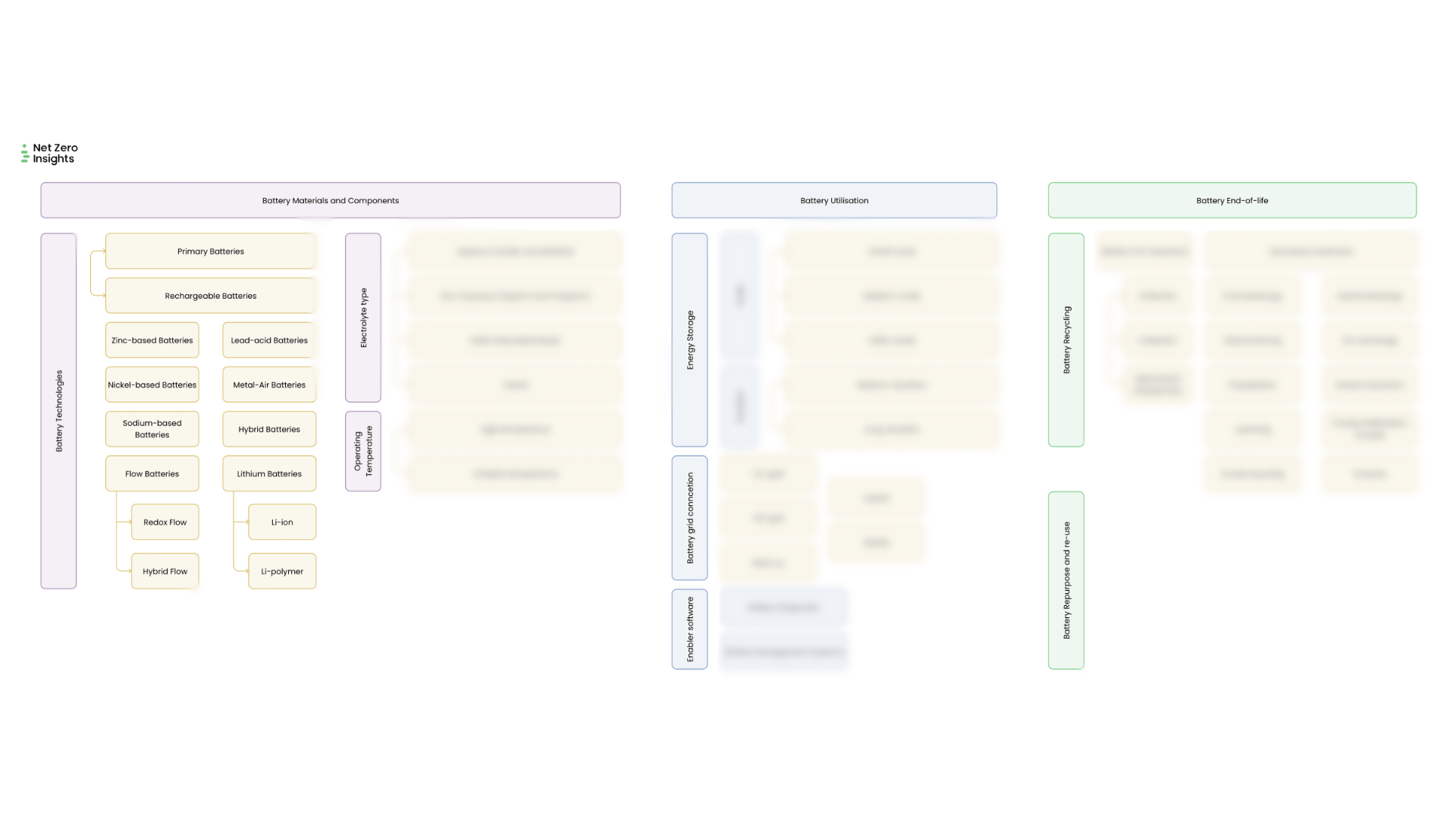
While innovation is happening all across the landscape, this article horns in on some of the most prominent battery technologies emerging to address challenges related to raw materials and storage.
⚡Sodium batteries
Sodium-ion (Na-ion) batteries offer a cost-effective alternative to traditional lithium-ion (Li-ion) batteries. Na-ion materials are generally safer, boast faster charging times and longer cycle lives, making them a viable option for EVs. Often produced with locally sourced materials, sodium-ion batteries provide a pathway to manufacturing independence from traditional battery value chains.
Some leading players within this space include Faradion, a company pioneering non-aqueous sodium-ion cell technology and NorthVolt, a clean energy manufacturer producing batteries with a 90% lower carbon footprint.
🤘Metal-air batteries
Metal-air batteries, which use ambient air as the cathode and pure metal as the anode, promise higher energy densities than traditional batteries. This technology, however, faces challenges in developing electrically rechargeable versions.
While some primary Metal-air batteries are already commercially available for consumer and industrial applications, electrically rechargeable metal-air batteries remain difficult to develop.
Despite these hurdles, due to Metal-air batteries potential for high energy density, they have attracted significant R&D funding. Companies like Form Energy and DayLyte Batteries have developed prototypes to increase the range of electric vehicles with the help of metal-air batteries.
🌊Flow batteries
Flow batteries store energy in liquid electrolyte solutions in external tanks, unlike traditional batteries that store energy within the cell. This separation allows for scalable energy capacity and adjustable power output, making flow batteries ideal for grid-scale storage or backup power. They also have a long lifespan since the electrolyte doesn’t degrade over time. Common production materials include vanadium, zinc, or bromine. Redflow, for example, is developing zinc-bromine flow batteries designed for stationary energy storage applications, whereas other companies use organic materials that are fully recyclable.
🔋Lithium-sulfur batteries
To tackle the Lithium-ion battery shortage, Lithium-sulfur batteries are being researched as a potential next-generation battery technology. This is due to their high theoretical energy density, cost advantages, and environmental benefits. Lithium-sulfur (Li-S) batteries have a different combination of materials than lithium-ion since they use sulfur as the negative electrode (anode). Sulfur is abundant and relatively inexpensive, which can contribute to lower manufacturing costs. With that being said, lithium-sulfur batteries have historically had life cycle issues since they degrade quicker than lithium-ion. Other challenges include volume changes during charge-discharge cycles, leading to mechanical stress and instability, which triggers the need for effective volume change management in the long run. Companies working on addressing these challenges include Lyten which recently secured $200 million in funding, and Eatron Technologies, which utilizes AI in its BMS to model to accurately analyze battery states.
Energy Storage Solutions: Alternative Paths
Of course, progress within the energy storage field isn’t limited to raw materials. In our platform, we’ve mapped innovations across the entire value chain, from battery diagnosis to management systems. Book a demo to learn more, or read about the key players reinventing energy storage.


